A little indicator on my prompt tells me the state of the git repo I’m in, if I’m in one. It’s quite minimal. Green tick: repo is clean; yellow cross: there are changes; red dot: there are merge conflicts. It’s a nice visual cue and for the longest time and the following code in my ~/.zshrc file made it possible.
|
|
This works fine. It does what it’s supposed to… It’s ugly though.
Time to take a long hard look at this function. There’s an if-else with three branches and I don’t much like an if-else past two. A case is better for that. I’m also grepping twice there. That’s two calls to an outside program, which case can do itself—and it’s even a shell built-in. Then I realised the worst part… Am I really calling git three times in here? Hang on. Three times for every prompt inside a git repo? That’s bonkers!
There must be a better way to tackle this. Isn’t there a way to call git once and derive the information I need from that one call? There is. It’s even in the function already! The git status --porcelain on its own basically has all the information I need. It returns line-separated file with a two-letter code in front of them, denoting the status of that one file. There’s no output if there are no changes. That solves the green tick. The red dot could be gotten from the letter code. A little google later and DD, AU, UD, UA, DU, AA, and UU are the codes that denote merge conflicts. That means that the yellow cross is also checked, as that’s all other possible outputs. That makes the following my new git function.
|
|
A few things worth pointing out:
git status --porcelainis git’s machine-readable output. The format is fixed and won’t change between git versions, so it’s safe to match against.|| returncovers being outside a repo. Theregit statusfails, the function returns nothing, and the indicator isn’t printed. That alone replaces the oldrev-parseguard from the top of the function.- The
casechecks three things in order. Empty output is a clean repo, green tick. A conflict code means a merge is in progress, red dot. Anything else means there are changes, yellow cross. - The check that looks the most impressive,
((|*$'\n')(DD|AU|UD|UA|DU|AA|UU)*), is not as hard as it appears.(|*$'\n')matches the start of a line: either the very beginning of the output, or anything ending in a newline.(DD|AU|UD|UA|DU|AA|UU)are the codes I found and*matches the rest.casecompares against the whole string, so without it the pattern would only match if the entire output were exactly two characters long.
Adding to prompt
The function hands back a string, so it slots into a prompt with PROMPT_SUBST turned on:
|
|
The box-drawing and the colors are mine, swap those for whatever you like. The part that matters is the $(git_status_prompt) in the middle.
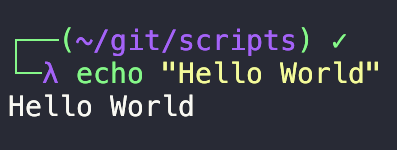
And that’s what it looks like on my system. You’ll have to try the function to see the other two indicators.
